The Great Prop Firm Shift: How Regulatory Pressure is Forcing Hybrid, Regulated Models
For the past five years, the proprietary trading industry operated in a regulatory gray area. The “evaluation challenge” model allowed firms to scale globally with minimal oversight, generating billions in evaluation fees while sidestepping traditional financial licensing. However, as we move through 2026, that era is definitively over.
Global financial watchdogs—including the FCA in the UK, ESMA in Europe, and the CFTC in the US—have shifted their focus from traditional retail forex brokers directly onto the prop trading sector. The future of prop trading firms will no longer be dictated by who has the most aggressive affiliate marketing, but by who can build the most resilient, compliant, and operationally sound infrastructure.
In this thought leadership analysis, we examine the regulatory squeeze, the rise of the “hybrid” prop firm model, and why operational excellence is the ultimate competitive moat for the next decade of proprietary trading.
The Regulatory Squeeze: Closing the “Challenge Model” Loophole
Regulators have historically turned a blind eye to prop firms, viewing them as educational platforms or simulation environments. However, as the industry scaled and real capital (or the promise of it) changed hands, regulators realized that these firms were effectively acting as unregulated CFD brokers.
The crackdown has manifested in several ways:
- Platform Vendor Enforcement: As seen with the MetaQuotes license revocations, software providers are now strictly prohibited from servicing unregulated entities, especially those targeting US or EU clients.
- Marketing Restrictions: Financial promotions regulations now require prop firm advertisements to carry prominent risk warnings, mirroring the strict rules applied to traditional brokers.
- Banking & Payment Scrutiny: Payment processors and tier-1 banks are demanding proof of regulatory licensing before onboarding prop firms, effectively cutting off the financial lifelines of non-compliant operators.
As detailed by legal experts at Lexology, the legal consensus is clear: if a firm is taking on market risk or acting as the counterparty to client trades, it will eventually be classified and regulated as a financial institution.
The Rise of the “Hybrid” Prop Firm Model
How are the smartest prop firms adapting to the future of prop trading firms? They are evolving into “Hybrid” models. Instead of operating purely as unregulated evaluation platforms, they are bridging the gap between the challenge model and traditional brokerage.
1. Strategic Regulatory Licensing
Leading firms are actively acquiring light-touch regulatory licenses in favorable jurisdictions (such as the SVGFSA or specific FCA exemptions for proprietary trading). This allows them to legally offer real capital allocation and maintain tier-1 banking relationships.
2. Brokerage Partnerships (The B-Book to A-Book Pipeline)
Instead of taking the other side of every trade, hybrid prop firms are partnering with regulated, tier-1 forex brokers. Traders who pass the evaluation are migrated to a live, regulated brokerage account where they trade with the broker’s liquidity. The prop firm transitions from a “counterparty” to a “talent scout” or introducing broker, earning a revenue share while completely offloading the regulatory and financial risk.
“The prop trading industry is maturing. The firms that survive the next five years will be those that transition from selling evaluation fees to building sustainable, regulated ecosystems that bridge the gap between retail talent and institutional capital.” — Finance Magnates Industry Analysis
Operational Excellence: The New Competitive Moat
In a landscape where marketing is heavily restricted and technology platforms are commoditized, operational excellence is the only true differentiator. Traders and affiliate partners are no longer swayed by massive bonus promises; they demand transparency, speed, and reliability.
The firms that will dominate the future are those that master three operational pillars:
- Flawless Payout Execution: The ability to process funded trader withdrawals instantly, without manual bottlenecks or arbitrary rule enforcement.
- Transparent Rule Enforcement: Utilizing advanced, automated risk management to ensure rules are applied consistently, eliminating the “hidden rules” accusations that plague the industry.
- Premium, Multilingual Support: Providing 24/7, empathetic support that resolves technical and financial queries before they escalate into public Trustpilot complaints.
Industry Predictions for 2026–2028
Based on our strategic advisory work at Prixim Global, we forecast the following macro-trends for the proprietary trading sector:
- Massive Industry Consolidation: The 80+ firms that collapsed in 2024/2025 was just the beginning. We expect a 50% reduction in the total number of active prop firms over the next 24 months as regulatory and banking pressures force the weakest operators out.
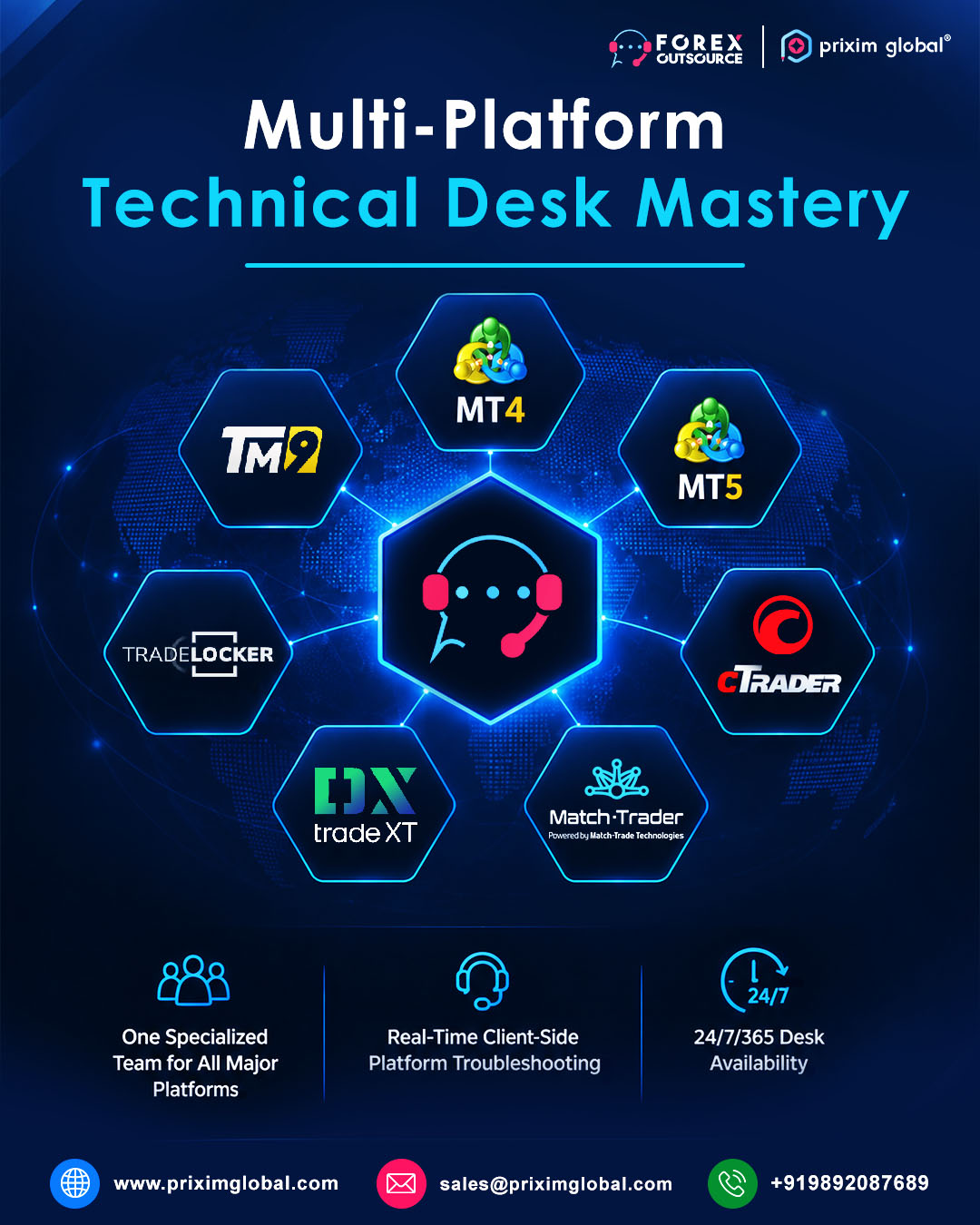
- The Death of the Single-Platform Firm: Firms will adopt multi-platform strategies (e.g., cTrader for retail, TradeLocker for challenges) to mitigate vendor risk.
- The Outsourcing Boom: To maintain high operational standards while managing compliance costs, mid-to-large tier prop firms will heavily outsource their back-office, KYC, and support functions to specialized B2B partners.
How ForexOutsource.com Future-Proofs Your Prop Firm
The transition to a regulated, hybrid model requires a massive upgrade in operational infrastructure. At Prixim Global, we specialize in guiding prop firms through this exact evolution. Through our dedicated division, ForexOutsource.com, we provide the enterprise-grade operational backbone required to thrive in the new regulatory reality.
We help you build the operational moat by providing:
Regulatory-Grade KYC & AML Processing
As prop firms adopt regulatory licenses, the compliance burden increases exponentially. Our certified analysts ensure your onboarding and transaction monitoring meet tier-1 regulatory standards, protecting your banking relationships. Explore our Compliance Solutions →
Scalable, Multilingual Trader Support
We deploy highly trained, forex-specialized support teams that handle complex platform queries, payout escalations, and affiliate communications across all global timezones, safeguarding your Trustpilot reputation.
Strategic Operational Advisory
Leveraging our deep industry expertise, we advise prop firm founders on structuring their back-office, optimizing payout workflows, and transitioning to hybrid, operationally sound business models.
Conclusion: Adapt or Perish in the New Prop Trading Era
The future of prop trading firms belongs to the operators, the compliant, and the technologically diversified. The days of scaling a prop firm on marketing hype and gray-label technology are over. To survive and thrive, firms must build robust operational foundations that can withstand regulatory scrutiny and deliver on their promises to traders.
Don’t wait for a regulatory notice or a banking termination to force your hand. Proactively upgrade your operational infrastructure today.
Future-Proof Your Prop Firm with ForexOutsource.com
The industry is evolving, and your operations must evolve with it. Partner with Prixim Global’s specialized division to deploy scalable, compliant, and expertly trained operational teams. We provide the infrastructure you need to transition to a hybrid model, protect your reputation, and dominate the next era of proprietary trading.
References & Industry Citations
- Finance Magnates – “Prop Trading on MetaTrader 5 Is Back in the US: The Shift Toward Regulated Models.” (High DA B2B Forex Industry News)
- Lexology – “Global Guide to Financial Regulation: The Reclassification of Proprietary Trading Firms.” (Top Tier Legal & Regulatory Analysis)
- B2Broker – “The Evolution of Proprietary Trading: From Evaluation Challenges to Real Capital Allocation.” (Leading B2B Brokerage Technology Insights)
- Prixim Global / ForexOutsource.com – “Strategic Operational Support for Forex & Prop Firms.” (Primary Source on Operational Structuring)